We are just back from a lovely family holiday on the coast of North Devon. Croyde, Woolacombe, Combe Martin. Beautiful.
And there, rockpooling every day, were fat people, pretty much wherever you looked. Including in the reflection I saw mirrored back at me rock pools.
Seriously. Over the past two or three years I feel like the obesity epidemic has crawled out of the newspapers, radios and TVs as a media story entity and into the playgrounds, swimming pools, schools and streets as a fully formed physical fact.
Isn’t it shocking, seen up close? How fat so many of us have got in the developed world. 😦
I cannot help but think about my diet, and diets and eating in general. I am a poor role model right now. And I cannot help but think about my kids and their diets over the coming years, and kids and their diets and eating in general.
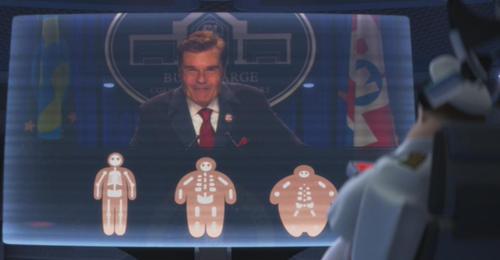
How right did Pixar get it with WALL-E? And how close are we already?!
More importantly, how will we overcome tomorrow’s challenges when we are in such morbidly poor shape?
This concerns me greatly.
Juxtaposed, I am reading some incredible output by two guys in particular on the topic of Resilience: John Robb and Vinay Gupta.
Both of their blogs are absolute must-reads for me. And both of their recent work is incredibly aposite and interesting. You need to read their work.
With these thoughts of fatness at the back of my brain somewhere, two other things collided in my head last week: the first from lusting at the magnificent brand that David Hieatt is creating over at HIUT, and in particular that gorgeous image of the light blue Land Rover Defender; the second from reading on John Robb’s resilience wiki Miiu about resilient cars.
The humble Defender is apparently one of the most resilient cars out there.
It appears on John Robb’s Miiu resilience wiki along with 25+ other ‘autos’ . The Toyota Prius, to my initial surprise, is not resilient by the Miiu community’s definition – it relies too much on the intelligence in its Engine Control Unit:
The basic engine integrated electronic component is called an engine control unit, or an ECU. Because resilient cars do not have advanced ECUs, they are easily fixed and tuned. A simple example of this is idle speed control, which in all new cars, is controlled by the ECU. The idle speed is controlled by the engine RPM. The RPM is monitored by the crankshaft position sensor, which is connected to the ECU. So, if the idle speed is too low, one would have to change it by tuning the ECU, which is an involved process. To tune an ECU, one would have to have an in-depth understanding of engine electronics and possess the knowledge and tools to tune an ECU. This is however, not the case in resilient cars. In resilient cars, the idle speed can be controlled mechanically by rotating a screw connected to the throttle that will increase or decrease idle speed.
From: http://www.miiu.org/wiki/Autos
In the future, the Defender and its fixable friends win.
And what of us, the humans? What makes for a resilient human? What traits should we seek to develop in ourselves, what skills?
There is a link here between the fat and the Defenders. I cannot quite draw it out, but it is here, just beyond my fingertips.
And though I can’t quite reach it, I instinctively know I want to be a Defender. Adaptable, fixable, resilient. And not too fat to help myself or others 🙂
 Will McInnes