What if it’s all our fault?

I had this really strange realization over the weekend, which is that it’s probably all our fault that the world is in the state it is (however you judge that state to be).

Our fault!

It’s quite a mad thought to me, that it’s our fault. Global warming, child poverty, human trafficking, nefarious politicianing, bribery and corruption – whatever it is you decide is wrong in the world: OUR FAULT.

Bit unfair, maybe?

But it was triggered by me realising how much plastic tat our two children have. Crap they don’t need, don’t play with, accumulated low-cost cheap-labour-created utter rubbish. And then I started thinking about the food we waste at home (I know I don’t look like I waste food, but trust me – I/we do :-). And how angry I get about the recent Guantanamo news, or Ian Tomlinson’s inquiry, or whatever, but know that I actually DON’T DO ANYTHING. I carry on.

And I thought about these words from Tom Bailey:

Work less. Consume less. Live more. Amen…. just as soon as the obscenely large job is out of the way.

Brilliant words that sum up my behaviour entirely!

How I’d love to do that, in theory, I mused on reading those words. But really? Really? Really I don’t seem to want to. I want to work MORE, have MORE, I don’t even know what I’d do if I had more time – either try and start a business or ride my bike more (I’m quite happy with the amount of time I spend with my beloved family!!). I just don’t do idling very well. So I carry on.

And if I’m carrying on, and not doing everything I can to change the world, then I have to take some responsibility – I realised.

The reason I write this is because that’s not the vibe I get from the world around me.

We don’t seem to collectively believe that it’s our fault. It’s big business, or politicians or whoever. But it might as well be Martians. Because by damning them, we’re absolving ourselves of responsibility. We are thus made powerless victims, unless I’ve misunderstood.

There are people I know that do rail against and do expend every piece of their capacity and available resources at making a difference, and I have nothing but respect for them. But I can think of one person – only 1 – that really does this. But we’ve seen around the world people exerting their power and making changes – massive, previously unthinkable changes.

So I’m starting to wonder if it does all come back to us. If it is, actually, our fault. My fault. My responsibility. Maybe by not changing it, I might as well have created it. I own it. It’s mine, the way the world is.

It’s interesting for me to think like that. Maybe one day I’ll do something about it. Maybe we all will.

My TEDx talk on ‘Radicalising Business’ through Happiness, Openness and Participation

I was lucky enough to be able to talk at the excellent inaugural TEDx Brighton, the theme of which was ‘Reasons to be Cheerful’.

What I wanted to do was to help spread some ideas that are already gaining their own momentum, but also to group them together in a package that I feel is hugely important, beneficial and practical for businesses.

The ideas are simply around harnessing Happiness, Openness and Participation in business.

Having watched it again there are things I’d deliver differently, but I’m still excited by the message and the opportunity that the world has to make this big ol’ business thing fundamentally better for all.

The video – 12 minutes 54 seconds

If you enjoyed, please find a way to spread the ideas – buy the books, tell a friend, share the video with a few people, implement the Happy Balls Blueprint at your workplace. This is too important to let go.

Thank you.

Sketches of the future

We are at a time when it would be good if I knew clearly what my plans are for the future. Maybe that’s the wrong way round – maybe I need to find out what the future has planned for me 🙂

I know that I’m loving my work at NixonMcInnes and am very excited about being part of taking it on to the next stage of its journey. There’s a good amount of work to keep me busy for the next few years! I feel like what we are doing there is preparing to embark on the next 3- 5 year phase.

But yeah, the longer term vision is less clear.

The things I do know are more like threads, themes, hallucinations or sketches. Small pieces, loosely joined 🙂

These are some of the things I enjoy:

  • Nurturing and realising talent – in people around me and in myself
  • Having meaning and purpose
  • New-ness – harnessing the near-future and right-here-now
  • Creativity
  • Humanity – being ourselves, caring
  • Proving a new kind of organisational DNA is not only do-able but actually *better*
  • Starting initiatives, maybe movements
  • Brighton
  • Adventures in foreign lands (current wishlist: USA, India, China)
  • Doing things differently
  • Fear and being stretched and challenged
  • Engaging with groups of people – from the training room to standing on a stages
  • Helping people
  • Learning
  • Sharing the journey – working with partners like Tom, Pete, Lasy and Jenni (so far)

The family

One fairly known thing is I think I would enjoy creating some kind of family of organisations. NixonMcInnes is the motherlode – the founding partner if you will. I think it would be cool to apply some of the practices we’ve developed and lessons learnt to other endeavours to see how that’d work.

This would also be tremendous given the immense and at times overwhelming potential of the people in our team. They can and already are seeding ideas that become projects that can become independent things. See Datacopter, NMStereo, Tellyflux, CityCampBrighton, Happy Buckets and more.

From a selfish point of view, to see them running their own gigs would be hugely gratifying (inside or outside the family – but inside would be extra cool 😉 ). Just an amazing idea that makes my tummy fizz.

So why – in the future – can’t we create our own kind of Y Combinator or Idealab?

And then there are more concrete possibilities or things I’m attracted to…

…ideas of shapes of things in this future

  • Maybe a product company – more of a traditional ‘startup’.
  • Something to do with food! Maybe local, specialty, healthy, tasty, high quality?
  • Maybe something social enterprisey – better let Tom go first though!
  • A progressive business school – a new form for this new world
  • Some academic research or collaboration
  • Something in Music or TV or Film
  • Publishing interests me
  • Schools interest me

So yeah. Funny how when I write it down it all seems clearer. That’s better.

The internet and Brighton, our digital city

The Argus, our local paper here in Brighton, asked me to write a piece on the social networks.

Earlier in the week I’d had an enjoyable conversation with Jo Wadsworth of that same newspaper about how I felt their news was disappointingly negative.

I really respect Jo’s opinion, and I felt I got a good drubbing and ended up the sad little optimist, defeated by a healthy dose of ‘reality’.

This summed up the conversation for me (click to biggify):
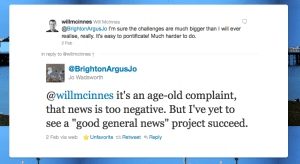
Conversation about news between Jo Wadsworth and Will McInnes

Good news doesn’t work – bah, grrr and nooooooooo!

Anyway, I wanted to write something that did address the dark side of the social web – the reality of snark, bile and polarised opinion. But maybe also highlighted some things we can do, some reasons for optimism.

It’s a bit long. I wouldn’t read it 🙂

———-

Let’s start with the dark side.

Perhaps it’s the grey weather, but I’ve been thinking recently that there are times when nowhere is darker or more negative than the web. A quick trawl of the comments on any newspaper website, videosharing or social networking space usually quickly reveal the very worst of our collective bile.

That’s tough for those on the receiving end.

The kind of specific, personal sniping previously limited to politicians, celebrities and other public figures is now reaching into all of our every day lives. Schools – see Varndean’s spat with a mocking if fairly benign student campaign in Facebook and now Twitter – and teachers, event organisers, colleagues and mid-ranking bosses, shop keepers, hoteliers, mums in the playground – are all at the wrong end of digital sniping.

The things is, most of us don’t really want to live our lives in the public eye – it’s not what we signed up for in life! But one effect that online social networks have is to enable gossip, leaked memos, photographs and general “snark” to spread instaneously and with much less hassle and effort than before. One dodgy photo uploaded and we could be Tuesday morning’s unwitting internet superstar.

A number of the web’s characteristics seem to lend themselves to skewing this aspect of the web towards the darkside, but anonymity is usually cited as the most influential. The fact that any of us can pretty easily conceal our identities online removes inhibition in a big way. No holding back! And for many this has evolved into a daily pursuit – ‘trolling’, the act of deliberately starting arguments online, and the constant invocation of Godwin’s Law (Google it).

Even so I remain resolutely positive about the impact that the internet can and already is having in society. Despite the bile and negativity, positively world-changing things are happening both generally and specifically in this city of ours.

If we play our cards right Brighton can really come into its own in the next decade. This funny little city of ours has somehow grown a community of digital businesses and organisations that stands out in Europe and perhaps beyond.

This community includes video game companies, creative agencies, digital marketers and a thriving sector of independent web freelancers and expert practitioners. It is a marvellous and mixed party pack of “internetty” talent.

In 2009 an HSBC report picked Brighton as one of 5 ‘Super Cities’ set to thrive in the emerging knowledge economy. With 11% of our workforce employedin creative industries versus a 3% national average, this isn’t a foamy marketing claim – this is real.

So what now? Given the shocking and continued impact that the recession and its fallout is having on many people’s livelihoods, I believe this is too serious an opportunity to be relegated to the ‘nice little media sector’ box.

This isn’t just a business or a ‘creative sector’ thing. It is and can continue to be a city-wide thing. The city council is making positive noises about both supporting this growth and also harnessing the power of the web to improve its own shape and performance. (When you have to reduce your budget by as much as they do, there’s a real imperative to change – but their kind of change is incredibly painful and wide-ranging in its effects).

Other associated movements in the city are gaining momentum and need to be nourished and celebrated.

The Open Data project, kindled by Greg Hadfield of Cogapp, describes itself as “a collaborative project to transform Brighton and Hove into a world-class open-data city, in which all citizens can together lead more rewarding, more prosperous, and more fulfilling lives”. That might sound a tad ambitious for us slightly sceptical Brits, but I do believe in this project. If we can embrace the disruptive changes that the internet will wreak anyway, and consider how city-life can be improved by opening up and joining up information sources, and show the rest of the world an example, then we will all benefit.

Take, for example, the link between information about public transport (like when the next bus is coming) and the challenge of creating healthier habits around exercise and reducing carbon emissions. Or the opportunity of matchmaking the time and experience that older people have, who are also often lonely – which is a significant health risk – with school-age kids whose reading ability is behind where it could be. If we can find city-wide ways to helpfully connect, we can truly improve lives.

The second and closely-related initiative worth joining in with is CityCamp Brighton. Again, this is a free, volunteer-driven effort to apply the skills and ideas of Brightonians to the goal of making the city better. With a sleeves-rolled-up ethos, open participation and serious attention from city leaders, this is your and my opportunity to get stuck in to the job of creating a more enriching future for Brighton & Hove.

By way of explanation and disclosure, we believe in the City Camp format enough to have ‘sponsored’ it through the leadership and hard work of Max St John in our team, working with The Democratic Society and Public-i, two other progressive organisations that care about this goal. I know they are actively welcoming involvement so do get on board.

When I think about the web, it can be overwhelming in its many facets – good and bad. Nevertheless, today the real potential of the web to make life tangibly better is slowly emerging, and with it is our chance as a city and a society to take a big step forward. The time for action is now: get involved.

——

Very good marketing outfits?

Question (from one of my business partners Pete Burden)

Can you tell me: if you were working in a big corporation or govt. organisation and you had a terrific totally new product that you thought was going to rock the world – a real game changer – not just a another washing powder to add to your already long list of cleaning and household products, which marketing agencies would you trust to help bring that to market in a stunning exciting way?

(Could be brand agency, could be advertising agency etc; but unlikely to be one of the big guys because this is so damn exciting that you wouldn’t trust one of the really big guys to do this in an exciting enough way…)
I didn’t have a particularly strong answer.
I said:
Really can’t think of anyone… 

I like people like Anomaly, Frog, IDEO and so on.
But they’re pretty established.
http://www.anomaly.com/
http://www.frogdesign.com/about/

The guy that created Gu (those chocalate puddings) used Big Fish.
http://www.bigfish.co.uk/

So I was wondering: who would you choose? Thanks in advance.

You know me, the President

I live in the future and I am the President / Prime Minister / CEO / Trustee / Mother / Father / Teacher / Religious or Community leader / person held ultimately responsible.

I am the guide, the role model, the leader, the holder of what is right and what should be.

I am, like you now are, in the public eye.

You can find photos of me, playing with friends, making rude gestures, drunk, sad, alone, with friends, high, doing things I shouldn’t be, wearing preposterous clothes.

Photos of me as a kid, as a teen, as young adult – it’s all there. First day at school, first day in a job, graduating from a college, first love, first tattoo / make-up / rebellious hair cut.

You can find words I wrote about streets, towns, cities, people, groups of people, the disadvantaged, ‘foreigners’ – disparaging, insulting, things written from passing trains, things written in bad moods, happy nothings, ‘what I had for breakfast’-isms, throwaway remarks preserved for ever more.

Reviews I wrote, fumbling exploratory blog posts I crafted, illustrations sketched, ideas half-developed.

Video upon video – built up over time like layers of soil and rock. Learning to walk, learning to speak, learning to ride a bike, learning to live. Hundreds, more like thousands of videos of amateur messy video of me, back then.

There are the streams of music I listened to, web pages I bookmarked, photos I shared, articles I commented on. Hundreds of thousands of emails. Video game scores, pseudonyms, handles, avatars and other identities.

It’s all there.

This is me, the President. You know me. So what is life like now?

The future-now of Publishing and Music

I have an innate love for the Publishing business. It’s a family thing and runs deep.

My mum was an editor and published writer, my uncle is a hugely talented professional illustrator, my Dad’s nickname – we found out through a school friend who had a part-time job at the local library in  Hove – was ‘Mr Library Man’ for all the yellow card tabs he’d bring in every week, ordering more and more books in 🙂

And so it continues: my sister works in publishing, so does my cousin.

But my love of publishing was never really to do with all that ‘big publishing’ thing. It was more the fact that I was able to create whole worlds of my own, sat on my own at home.

I used to write stuff at home, stuff for Dungeons and Dragons that was mainly just for me, a highly profitable, highly inappropriate every-so-often newsletter for my Air Training Cadets ‘squadron’.

And the miracle was hitting PRINT and seeing my world coming to life – leaving the old Apple Mac and entering the real world. It’s that paper thing, that tangible thing, that same moment when you get your first business cards done, or see your website go live. Freedom! Self-expression!! BOOM.

For those kind of reasons I’m really really gripped by how publishing is evolving at the moment, right before our very eyes.

Industries are supposed to evolve over years – like glaciers – but watching the Publishing, Music and Big Media businesses, it really feels like watching a timelapse video turned up to 11. The changes happening right here, right now. It’s not a distant future, but more like a future-now.

Of particular interest and excitement to me are:

  • The impact of Kindle and iPad on the book publishing world
  • The grasping for new business models in the music business

In the book publishing world I am fantastically excited by The Domino Project – its DNA a double-helix of Seth Godin the digital seer, and Amazon the gigantically successful ecommerce and digital content business.

If they can’t make a dent in the problem of how to really create value with content in a networked world, I’m not sure who can.

And this whole post was prompted by this short but very interesting Nieman Lab piece on how libertarian economist and published author Tyler Cowen has published his latest book as an ebook only at $4.

This is the pivotal comment, for me:

JB: If the ebook platform didn’t exist, what do you think you would have done with the book’s content? Chop it down to a magazine piece? Turn it into a series of blog posts? Inflate it up to 250-page hardcover length? Would it have found a useful life otherwise?

TC: No ebook format, no book. At least in this case. I may try the format again, of course. I don’t like to stretch ideas to excessive length and magazines often want everything to be driven by the anecdote, which doesn’t really fit here.

Here’s a guy in control of his destiny – multiply published in real books, with a very successful blog behind him, choosing a digital format because it suits his goals.

Not about desperation and survival, instead this is about picking and chosing, about having real options, and addressing the digital world as a true native, not a latecoming and awkward newbie.

In the music business I have less practical experience and knowledge, but through a friend who has been a successful artist in a top-selling band and who now manages a number of acts as a professional manager I’m starting to learn just how much needs to change in that world.

This friend is trying to create a new kind of organisation in music: cutting out major labels, managing and actually incubating the talent, bringing into their influence the relationship with the audience, testing and proving/disproving the 1000 true fans model, rejecting the 360 degree model, creating direct and warmer relationships with their fans, and trying to invent new sustainable business models. Cool challenge eh?!

If I was going to do a start up today, it would definitely be in the media ‘space’ – you have to call it a space when you’re talking startup lingo (as a friend said – what happens if you’re in the Space business, do you call it the space space?!!) – probably not music because I know the least, but certainly publishing or possibly TV (which I haven’t touched on because I don’t need to – see my colleague Anna’s fantastic Tellyflux blog on the future-now of TV).

Amazing times.

Thank you, TEDx Brighton

Thank you for a great day.

If the job of TED is to spread ideas worth spreading, and the job of TEDx events are to reach further into diverse networks and geographies and expose more talent and reveal more ideas worth spreading, then I think the first TEDx Brighton was very fucking good.

I’ve heard different people say different talks worked for them – the beauty of different tastes and the cross-pollination of new ideas from other worlds – but for me the talks which gave me the most were David Bramwell’s talk on Utopia, Dr Judith Good’s talk on Learning & Technology, George MacKerron’s talk on Mappiness and Sarah Angliss’ talk on music and machines.

There are some thorough overviews written up by participants there on the day:

And some excellent accompanying notes from fellow speakers Antony Mayfield and Sarah Angliss:

Isn’t great how people create such useful content eh, audience and speakers alike?

As a side note, it must be blooming hard to organise successful events.

Personally I never regret handing over good money for a great event and respect the job of organisers – so much prep, so much stress, people grumbling about wifi and coffee, speakers cancelling last minute, equipment suppliers forgetting to deliver the right kit.

So a peak of activity – one shot to get it right. And when it does – BOOOM! A high for everyone.

And then those magic unicorns that are fantastic events with no or a very low cost attached. Crazy cool. I’m thinking of Interesting, The Story. Stuff that good.

For me, TEDx Brighton was up there with these. And that was the first one – the prototype – and inevitably I imagine there will be things to roll into the next one, of which it sounds like there is already talk of…

So I’d like to say thank you – to Tom Bailey the producer and his team of volunteers, to the audience and other speakers, to the sponsors. The whole enchilada, Mother Nature and the UNIVERSE. Thank you.

And for me personally a massive thank you to my team – usually when I do speaking gigs, it’s a very solo experience from inception to delivery and the knackered journey home. There wasn’t a single person in our team who didn’t help with the TEDx talk – I did 3 practice run throughs (!) – yep, it was too important to wing it out without some proper PREPARATION! Loads of moral support and back up. It was cool to feel massively supported.

That event was and will continue to be great for Brighton. Thank you.

Tracking my internet addiction

The Christmas and New Year holiday was wonderfully restive and felt everlasting.

But one thing I didn’t do was disconnect from the social web (I usually do on hols – and am well ready to forgo the Twitters and the Facebooks :).

In fact, I borrowed the company’s iPad, and found myself spending mindless hours almost every evening after the kids went to bed, just cycling between Facebook, Twitter, my favourite mountain biking forum, my second favourite mountain bike forum and a few bikey ecommerce sites. I found that the iPad is the ultimate sofa device.

These were, I’m afraid, empty hours. 97% pointless. And I slowly became more conscious of how I was rotating between each site, searching for something new and alive to pique my interest.

Coming back to work was always going to be interesting and yesterday I felt totally disorientated. I also felt angry about my cravings to check to see the new on the web, so I started a little tracker.

Here it is so far:

So yesterday morning, as I started the important job of pulling my thoughts and then slides together for the Brighton TEDx in about 3 weeks time, every time I felt the physical urge to go check the internets for something new, I scribbled a tally on a post it.

The black ink is yesterday between 8 am and 11 am, and the red ink this morning between 8.30 am and 10 am.

The research I’ve read seems to vary about how distracting or what the time cost is of each distraction (that is, each distraction indulged in), but it seems to be something between 15 minutes to get back to the same level of concentration upto 45 minutes [1].

It’s really scary to me – I feel like I’m facing up to a habit that doesn’t serve me, the truth of something that controls me more than I control it.

Especially when I think about how much I want to get this talk right, which has been the sole task of these two morning slots – my most productive in a given working day.

In some small but real way, each scrawl feels like a bullet dodged, a computer virus snaffled, a cigarette or burger not consumed. There’s a superiority that comes with avoidance (little victories!).

But isn’t it addictive, this thing we do? I know the research is out there, but this is me, my attention, my life.

Further reading:

[1] http://www.pr2020.com/page/the-unplugged-experiment

The Four Hour Work Week, and all that other GTD / work/life hacking type stuff.

PS. I know my views on this are a little tradition, someone like the awesome Stowe Boyd might encourage the always-on-ness, and celebrate being an inforvore. I see truth in that too, but still feel the above – the two feel directly opposed, in tension.