#cltrshck weekly ammo

Ready for some brainfood?

I’m putting together a weekly gaggle of snippets and links that relate to Culture Shock, its mission and the interests of its writer and readers.

If you’re a one-time visitor, and want to receive these and my other blog posts, sign up yo’ email address in the top right of my blog and you’ll get mailed each post as it happens (usually 1 to 3 pieces a week).

I’m calling it ammo, cos this is motherfricking revolution 😉

————–

Who’s the Boss? There isn’t one. – Wall Street Journal piece on companies operating in more empowered and democratic ways. Includes Gore (in Culture Shock) and Valve (who damn well woulda been had I come across them before I wrote the book).

What I love about this piece is the expression of some of the downsides of these ways of working – things that current and past NixonMcInnes team will know well, including:

The bossless structure can be chaotic at times, he says, but “you feel like there is total trust and an element of freedom and ownership. It makes you want to do more,” says Mr. Clem, who had previously worked at a large tech firm and smaller start-ups.

Valve Economics blog – Yanis Varoufakis. For those of you who wanna dig right into Valve in depth, check out this blog by their in house economist (how cool is that?!). Thanks to Dave Boyle for sharing this.

————–

Culture inside and outside the corporation – Grant McCracken blog post via super-smart Antony Mayfield. What I love is the truth that when new employees join they get the freshest expression of the ‘culture’, but not the messy, layered, living reality of culture:

Good luck onboarding a new hire. A handbook may capture the most recent, the most explicit, and the most formal of the ideas and values that govern the culture, but that teeming mass of additional ideas it tends to leave out. It will take weeks, sometimes months for the new hire to glimpse all the ideas at work in the corporate culture and the rules that govern when and by whom they’re used. Time wasted. Value squandered. And sometimes a lost hire.

————–

Commons: Alternatives to Markets and States. Piece by Derek Wall in Energy Bulletin. No idea how I came across this one – sorry, sharer of good content! And I haven’t read it beyond the fifth paragraph. BUT. Dan McQuillan, a guy who has consistently blown my mind with cerebral ideas over the last 6 or so years, did a great talk at Social Business Sessions about the Commons. And I know, just know, that there’s something huge in here, something so important that I’m not even ready to peek at it yet. So if you’re ready, start reading 🙂

————–

37signals Earns Millions Each Year. Its CEO’s Model? His Cleaning Lady – Fast Company magazine. Yep, so we’ve all read glowing 37Signals articles and books before, right. But when you read what Jason is saying here, and think about their 35 employees and huge impact, revenues and profits, their sustained journey, and contrast with the ‘sickness’ he talks about that’s represented in TechCrunch, he’s really really REALLY onto something:

I won’t name names. I used to name names. But I think all you have to do is read TechCrunch. Look at what the top stories are, and they’re all about raising money, how many employees they have, and these are metrics that don’t matter. What matters is: Are you profitable? Are you building something great? Are you taking care of your people? Are you treating your customers well? In the coverage of our industry as a whole, you’ll rarely see stories about treating customers well, about people building a sustainable business. TechCrunch to me is the great place to look to see the sickness in our industry right now.

————–

For me, all of these are so #cltrshck it hurts. I am genuinely uplifted by this rising tide of related ideas about how to make things better, seeing these practices gaining profile and momentum.

Let me know if you have any feedback on this format. And please keep sharing them links.
Modern slaves

After writing Culture Shock I went on a bit into a bit of a sofa-slouching-brain-resting phase: bought a PS3, developed a bad habit around Battlefield 3, and stopped reading business books.

I’m sort of still half in that phase. Still can’t get my head back into business books, for example.

Good things came of this slovenly phase. I learned a lot from getting back into video games and ended up writing this piece for Wired UK: ‘Modern business is a video game: a bad one’.

I’ve also been bingeing on the Game of Thrones books. Basically ‘fantasy’ Lord of the Rings-esque series, describing the rise and fall of elite families and their characters in a mythical world. Brilliant, easy reading for a geek like me.

(Sorry for the long intro here – I’m winding up to something interesting, I think…)

All of which is a long way of saying that I’ve been spending an hour or so a night in bed immersed in stories of a feudal world, with the hierarchies of old – from Kings and Queens down to filthy poor peasants and slaves.

At the same time, consolidation in the social media and social business sectors has continued. Many of our peers have now sold their businesses to bigger companies, all part of that natural ecosystem of business, where the entrepreneurs reach the end of their natural phase, want to move on to the next thing, and where incumbents want to buy in some of the sizzly new stuff. That’s all good: I’ve been really happy seeing people I like achieve their goals and more and more I can see the sense in this cycle.

In my head these two things have begun to relate: the fortunes of the Lords and Ladies of a fictional world and the accomplishments of entrepreneurs in my world.

And for some reason I’ve started to get this idea that most people are modern slaves, at work. Or at least, disempowered and mistreated peasants. (I know many people aren’t, but this is a dramatisation, mkay!?).

If we pretend that most people are ‘modern slaves’ at work, toiling away to produce the lion’s share of rewards for a small royal elite (shareholders and senior management), when it is in fact their work that creates the rewards, then I can’t stop thinking about employee ownership as the only way forward.

In fact, I’ll go further: I believe that within 15 years, all businesses will have a significant proportion of employee ownership (let’s say more than 25%). That’s probably wrong – if it were to happen, would probably be the greatest shift of wealth ever in the history of the world or something. But it’s just what I feel intuitively – no science included.

Entrepreneurs deserve a premium for taking risk and the act of creation and early growth. I feel that strongly, personally. And shareholders deserve a reward for their risk and investment. But it feels too much, too far skewed at the moment, to me.

I am conscious that this creates a dangerous expectation for me as an entrepreneur. Personally, despite what I’m saying I would like to do a traditional ‘exit’ at some point. I think it would be interesting, exciting, and a nice lump sum would be useful too. As for NixonMcInnes (where I don’t think that’s likely), I personally think that increasing the employee ownership from 5 of us (25%) to 90%-100% would be a brilliant outcome. So what I am saying isn’t free from hypocrisy, expectation-setting or whatever: I’m talking the talk – it remains to be seen if I (and others) can walk it.

But yes. There it is. When the millions go to the few founders and executives, and the rest of the organisation usually resembles a pyramid, with most people earning not very much at all, have we really come very far in the past thousand years? Outliers like John Lewis and other-brilliant-companies-owned-by-their-staff are just that – outliers, quirks. Isn’t that a bit weird?

Aren’t most people just modern slaves, when they are toiling for others?

And won’t that necessarily change as things are becoming more transparent, people are better connected, work tools are lower cost and more accessible, and more of us in the UK work in knowledge work where the product is the people?

I think so. That’s why this topic is in my book, and why we have Margaret Elliott speaking at Meaning 2012 about her experiences creating and scaling up successful employee-owned businesses here in the UK.

But now I believe in this even more – more than when I wrote Culture Shock, more than when I curated the original speakers for Meaning. Ownership belongs here, where it happens, not somewhere else – best of all, in the hands of the people doing it. In time, this will be irresistable.

What do you think?

Other voices from the tidal wave

If you are interested in the things I write about in Culture Shock and we are curating around Meaning 2012, you should pay attention to these three voices too:

Tom Nixon’s blog‘Using democratic business & employee ownership to reinvent capitalism and make the world a happier and sustainable place’

Tom is the co-founder of NixonMcInnes, my original business partner and a great great guy. He is currently writing up a storm as he travels the world, kicking about issues around the reinvention of capitalism, employee ownership, and other good stuff.

Must read.

Alan MooreSMLXL

I am about a fifth of the way through Alan’s new book ‘No Straight Lines’ and I read that first chunk thinking ‘man, we are so on the same wavelength’. Alan’s style is different to mine – there’s a whole load more evidence, tons of references, and a different tone, but the story he is telling is the same I think. That is, things have to change fundamentally and disruptively.

Following Alan’s ongoing blog writings seems to be a clever thing to do, and grab the book too if you haven’t already.

Conscious Business UK‘Business, but different’

Conscious Business UK is a blog where a collective of likeminded people share ideas about the evolution of business.  At the core of that collective are a few very smart people including Pete Burden and Lasy Lawless, who are both also directors and owners of NixonMcInnes (this isn’t a backslapping fest, honest), but in their spare time they wear other hats, growing a consultancy called SeeStep which seeks to develop ‘conscious business’.

The different perspectives on this blog work really well, and I particularly liked this post by Lasy on ‘Evidence for Conscious Business’ which is packed with credible research to back up these ideas we are all promoting.

Add these three further voices to your regular reading if you are as interested in this tidal wave of change we are seeing. This thing is big, and growing.

Culture Shock is out – get ’em hot

Hello friends,

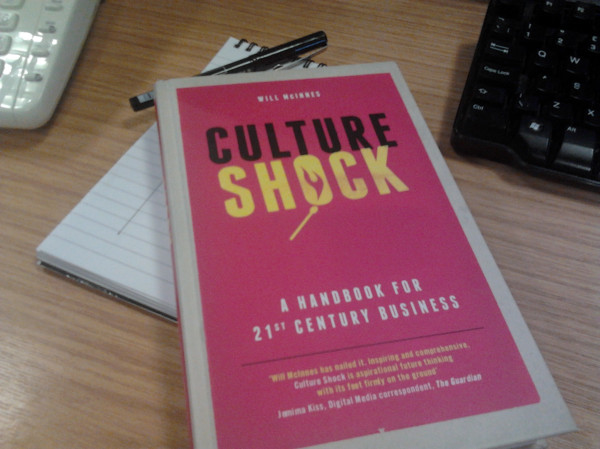
THE TIME IS NIGH! The book is out – see photographic evidence of a Culture Shock out in the wild on someone else’s desk.

culture shock book will mcinnes

Get yer copy, and please review it in Amazon and share your thoughts with me.

BUY NOW BUY NOW BUY NOW. <— I used to work in marketing.

For me personally it’s a weird old feeling, seeing a book come out with your name on it. I’ve moved from excitement and fatigue, post-completion, to antipathy and mild warmth in the quiet middle bit, to now a state of excitement and anxiety now that it’s no longer a game but a reality. Terrified of negative reactions, hopeful of new doors opening and a deluge of new connections with people that believe in the same things. Expect most first-time authors have felt something similar.

I know my publishers at Wiley (hi Jonathan and Megan!) feel we have lots to do on the promotion front, so I’m conscious of the mountain we need to climb there, and also of not spamming you guys in my immediate network too much. But you early believers and friends are the crucial first wave!

Thank you again for the help and support many of you gave along the way.

Got a nice bottle of wine to celebrate tonight with the Mrs.

With love 🙂

Will

Join us at Meaning 2012, an event on the future of business

With my clever co-conspirators at NixonMcInnes, I’ve been helping to organise Meaning 2012, an event about the future of business.

It is HUGELY exciting.

There are future tech conferences, events about employee ownership, about happiness, and lots more. But no one event – we felt – pulled all of the related strands that make up the progressive future business we want to see in the world. So we decided to put one on ourselves.

Our speakers are the very best in their fields, drawn from an international pool and are going to blow our minds.

So far we have:

•    Umair Haque, the mighty rogue economist and leading management thinker
•    Caroline Lucas, MP and Leader of the Green Party
•    Stowe Boyd, wise author and social tools researcher
•    Alexander Kjerulf, brilliant happiness-at-work expert
•    Vinay Gupta, inventor of the hexayurt and clear-eyed critic of the status quo
•    Margaret Elliott, employee ownership advocate and inspirational do-er
•    David Hieatt, founder of Howies, The Do Lectures and now Hiut Denim
•    Professor Karen Pine, infectiously upbeat and challenging behaviour change expert

And participants are signing up from all over the place.

If you’re interested in progressive business, in the topics I cover in my book Culture Shock (out this coming month!) and all that other good ‘let’s change this’ stuff, join us at Meaning 2012. It is going to rock.

Meaning 2012 conference tweet

Open salaries on ‘Show Me Your Money’, Channel 4

If you follow this blog, I reckon you’re interested in progressive business practices.

You NEED to watch ‘Show Me Your Money’ from Channel 4 tomorrow evening.

It’s a documentary about a company experimenting with open salaries, something we’ve done at NixonMcInnes since our inception some 10 or 11 years ago. And something I write about and promote in the Fair Finances (chapter 8) of Culture Shock.

But whilst it feels right, and better, it’s not easy – in fact, it’s gotten harder for us as the years have progressed, so it’ll be fascinating to see how these guys (a plumbing firm, I believe) get on.

More from Channel 4 here: http://www.channel4.com/programmes/show-me-your-money/episode-guide/series-1/episode-1

So very, very Culture Shock and Meaning Conference eh!

Do let us know what you think… be great to hear reactions 🙂

(More exciting is seeing this movement grow, seeing the swell gradually build up into a rolling wave. This is the future of business. THIS IS IT, PEOPLE).

Designing for the psychopath

A while ago I went to hear Jon Ronson talk about his new book on The Pyschopath Test. As you’d expect if you know Ronson, the talk was both droll and fascinating. But there was that thing, again, about how many leaders may be psychopathic.

Then, in this last week or so, with more outrageous behaviour at banks here in the UK and the attitude of some of their leaders it led to a discussion – probably with Jenni – about what to do with psychopaths. And, in this pop science pub conversation, we were considering non-murdering psychopaths – those that get on and progress especially in business due to their personalities and traits, (though I admit I have no idea what I’m talking about) but don’t kill people (directly).

The question is, as society evolves is there a role for psychopathic people in life and business? What can they offer to the common good? How can they contribute? It would be easy to assume that we want a world only populated with compassionate, empathic, considerate people – that does sound quite nice, actually. But is it true?

Or to put it in the words of software developers, are psychopaths a feature or a bug in society? They seem only to be discussed as a bug, an issue that needs to be fixed.

In this pub conversation we agreed that it is easy to bemoan people who appear to have no regard for others, and the kind of audacious, utterly cold and ruthless decisions that these kind of CEOs and political leaders make. But is it possible that we need them more than we realise? I’m willing to entertain that idea.

And in the future, from the perspective of inclusion and also from using the resources we have to get the best outcomes for as many people as possible, why would we segregate people with these traits and condition any more than anyone else?

If we were designing a better world, wouldn’t an enlightened future world actually place these people in roles that suited their unique talents and abilities, and provide counterbalances and stopping mechanisms to optimise their positive contributions, whilst limiting the awful consequences of unhindered decision-making?

Culture Shockers, meet Social Business Sessions

Fans-of-a-better-future: a quick note that for those of you based in the UK, we run a six-weekly event called Social Business Sessions where we discuss many of the issues covered in Culture Shock.

Next week we have three speakers:

– on Complexity & Social Movements,

– on Brands with Purpose

– on Activism and social organisations.

Hand-picked speakers, small group size, emphasis on discussion.

Do come along if you’re free, either next Thursday or at a future Social Business Session

(Book-wise, your feedback went to the publishers, along with final pre-proof edits and we’re starting to move into proper production and promotion. Book is up on Amazon, will be out in August and we’ll be doing the promotional push in September. All good!).

Every Business becomes more Family Business

Just had lunch and another stimulating conversation with Ollie Glass, our new creative technologist at NixonMcInnes. Ollie is a very clever and interesting guy.

He passed on this ‘off-hand remark’ that someone had made about how family businesses have tended to outlast corporations where the shareholders are, I’m guessing, not tied by family. (Will see if I can dig this out, but for now I want to play with the ideas rather than get into the data).

What this got us thinking about was what is it about family business that leads to these long-lasting dynasties? And what, if anything, can non-family businesses learn?

For me, family and business are two words I’m not keen to mix! I have a strong desire to keep different parts of my life quite separate – family, work, friends. I like the clarity and the ease that I feel comes with that. And I also really need and value the sanctuary that family gives me from the mental demands of work. It helps me to have them apart.

I also hate the idea of tip-toeing around a family that work together, or worse, of me and my family inflicting our bickering onto them. Could anything be worse than that?! 🙂

But when I think about the potential goodness that can exist in family business I start to feel that there could be some enormous good in there for the wider business community to take inspiration from.

When Carole Leslie from the Employee Ownership Association visited us a few weeks back to talk about employee ownership she told us that one of the most common paths to employee ownership was a family business where the founder wanted to pass her or his company on to their children, but the kids weren’t interested.

In order to keep the culture and fabric they’d built, they looked to employee ownership.

So what is it they fear and resist about, say, the trade sale – the most common alternative? What is it that another business cannot provide?

And if family businesses last longer, is there something about their fabric, their shareholder mindset, the decisions they make and the priorities they place on things that the rest of us can learn from?

Thinking about shareholding in particular, is it the connections between the shareholders that do something good in family businesses, rather than the federation of individual interests all pointing towards a single objective – capital appreciation (and I guess, dividends) – with corporate shareholder bases?

Or is it the shared values? Or the drive for legacy and dynasty? Or the personal reputation, the realest of real skin in the game?

As we begin to work towards an evolved 21st century kind of business, are we actually heading full circle – returning to long-standing and long-lasting principles that millions of enterprises have been built on since civilization began? Will every business become more like the good parts of a family business?

In the virtual organisation, where is home?

There’s this huge momentum towards fluidity at work – to remote working, to portfolio careers, job sharing, the rise of ronin / freelancing, work life balance, Skype, yammer and the Cloud and so on.

For us as individuals, as workers, there’s lots to like in all of this. We are unleashed! I can work from anywhere! When I want, how I want, with who I want (and so the dreamy hype goes).
And there are – of course – tons of benefits for organisations and businesses too who have been keen to capitalise on these.

But in this working world, if we are all remote and virtual and part of loosely formed networks around projects that quickly form and then dissolve, then where is home?
Where is the centre of gravity that binds and anchors and provides that sense of HQ, of the mothership?

We know what we gain with fluidity, but what do we lose when this base goes, both as workers and business owners?

This all occurred to me after a week where I spoke with two different Managing Directors of consulting firms, both much more fluid than NixonMcInnes.

One firm was entirely geographically distributed across the States, with 20 people peppered across the whole country. Their consultants were mid- to late-career, so pretty grown up, experienced business people and the consultancy operated a reasonably traditional ‘eat what you kill’ mode of rewards. No central staff, no support or admin people not earning fees, no geographical centre of operations. Certainly makes sense from a financial bottom-line point of view.

But not everything about the consultancy was traditional – like us they do some more radical stuff in how they work together. Their MD told me that they tried to get everyone together three times a year. THREE TIMES, I thought, as I thought of how frustrated I get when we struggle to get a decent turn out for weekly team meetings, given all of the important, useful stuff there is to relay and the constant challenge to satisfy people’s desire to know what’s going on.

The other MD runs a consulting firm also in Europe that does have a centre of gravity, an office with a small central staff and then consultants distributed in different countries, all working from wherever they want to work from. But we were talking about how that might not always be a good idea commercially.

The third thing rattling round in the same tumble-dryer of background thinking was the 37 Signals case study of distributed team, connected by digital tools, and their Meetings are Toxic mantra. They are world class in what they do, they seem to do ok without lots of face to face meetings – theoretically one of the key benefits of a central HQ.

And these conversations and thoughts made me think about what we’ve been doing with NixonMcInnes.

We’ve been deliberately developing a real physical heart, and so have invested our office space, in having administrative and marketing support, and in developing a cohort of people living and working in the same county, and almost entirely in the same city.

It’s like we are walking directly against the tide. And that’s confusing (although not unusual for us).

I wonder what organisational benefits we derive by having a home. Or are we just doing it because of the preferences of the people in the organisation, and if so what does that cost us and do we acknowledge that?

Also, do we gain competitive advantage? If we compete with a distributed firm, are we more likely to win or is the playing field level apart from the extra financial resources they have saved from central costs?

In theory, I would expect benefits to show up in areas like these:
– in trust, resilience and therefore quality under pressure in the relationships between team members leading to client retention, referrals and project profitability
– in people’s happiness and engagement at work (even as I write this one, I’m starting to question it) leading to talent acquisition and retention
– in communication between team members which then drives quality to clients and profits for the company through saved time (again, I can quickly think of counter arguments…)
– in pitching for clients business, and them having the comfort of the physical tangible sense of a team and a business (having seen the networked agency model many times I am actually more confident of this point for the time being though I think it will change over time)

Are there others?
Are these flawed, am I drinking my own Kool-aid?

The thing is, I know I want to be part of something and to me personally I like the physical part of that, the offline, the home. And I believe others do too.

But there is a tidal force here. And a string of benefits as well as costs that we are only beginning to understand.

Given all of this, I do wonder with some interest how the traditional physical centre of gravity at the heart of an organisation will change in this next generation of work.

